
It is cold, the heating is expensive, and there is a perfectly good heater sitting on the bedroom floor. The temptation is completely understandable.
This page will not pretend the answer is complicated. It is no, and the reasons are worth reading because they are not what most people assume.
The risk is not mainly that the heater catches fire. It is that the heater sets something else alight while there is nobody awake to notice.
There is a section at the end on what to use instead, because telling someone to be cold is not advice.
Is it safe to leave a space heater on overnight?
No. The U.S. Fire Administration's rule is one sentence long. Turn space heaters off when leaving the room or going to bed.
Manufacturers say the same thing in the manual, usually in the first few lines, and it is not legal cover. It reflects how these fires happen.
The disproportion is the part that should land. Portable heaters are a small fraction of heating equipment in American homes, and they are involved in an outsized share of the deaths.
Read that ratio twice. These appliances are not simply causing fires, they are causing the fires that people do not get out of.
The wider heating picture puts numbers on the scale, and using a space heater safely covers the daytime operating rules in full.
Why does the night change the risk so much?
Because detection and escape both collapse when everyone is asleep. The fire does not get worse at night. Your response does.
A smouldering cushion in the afternoon gets noticed in seconds by whoever is in the room. The same cushion at two in the morning has ten minutes to itself.
There is a second factor people forget. Smoke does not wake you. It deepens sleep, because carbon monoxide impairs judgement and consciousness before it does anything else.
That is what smoke alarms exist to solve, and it is also why a heater in a bedroom with a dead alarm is a genuinely different proposition to one in a hallway.
Been running a heater overnight and now there is a scorch mark, a melted spot on the cord, or a smell you cannot place? Stop using it and get the wiring checked.
(844) 810-6096What actually goes wrong while everyone is asleep?
Not usually the heater exploding. Four ordinary things, in roughly this order of frequency.
- Something combustible gets too close. A duvet slips off the bed, a curtain moves in a draft, a pile of clothes shifts.
- The heater tips. A pet, a child, a foot in the dark, or a rug edge, and the guard ends up face down on the carpet.
- The outlet or cord overheats. A heater draws around 1,500 watts continuously, which is close to the limit of a household circuit.
- The unit fails. Dust in the element, a worn thermostat, or a fan that stalls while the element keeps drawing power.
The first one is the big one. More than half of home heating fire deaths come from heating equipment being too close to things that can burn.
That is a spatial problem, and a bedroom is the worst room in the house for it. Beds, bedding, curtains and clothing are all combustible and all mobile.
The clearance rule that solves it in daylight is covered in how far a space heater should be from furniture, and it does not survive contact with a sleeping person.
Do tip over and overheat switches make it safe?
They make it safer. They do not make it safe. They are a backstop, not a babysitter.
A tip over switch cuts power when the unit leaves vertical. It does not help if the heater stays upright and a blanket lands against the front of it.
An overheat cutoff trips when the internal temperature climbs past a set point. It protects the heater. It does not know that the curtain beside it is at ignition temperature.
Both are mechanical or thermal parts that age. On a heater that has spent five winters in a dusty closet, neither has been tested since it left the factory.
Buy units with both features and with a recognised safety certification mark. Then still turn them off at night, because the features address the wrong failure.
Can you leave a space heater on overnight in a child's room?
This is the one people ask most and it is the clearest no in the whole page.
Small children cannot reliably wake, orient and evacuate. That is the entire reason the night statistics look the way they do.
A child's room also fails every clearance test. Soft toys, bedding on the floor, curtains, and a small person who moves things around without being asked.
The same reasoning applies to anyone with limited mobility, anyone who takes sleep medication, and anyone who has been drinking.
If a room is genuinely too cold to sleep in without a heater, run the heater before bed with the door shut, then turn it off and let the stored heat carry the night.
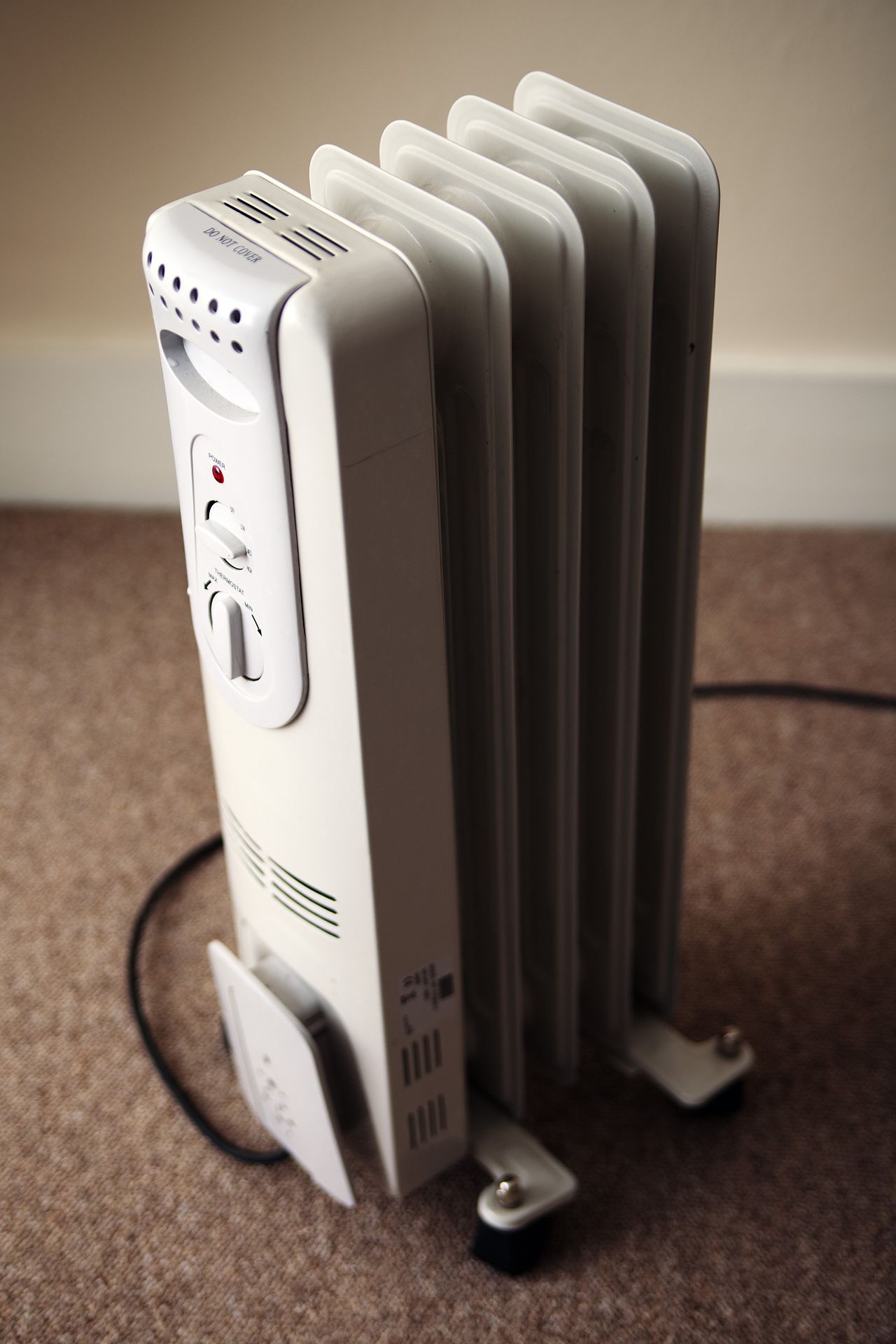
Is an oil filled radiator different?
Lower risk, same rule. Lower is not zero, and the answer for overnight use does not change.
Oil filled column radiators have no exposed element and a much lower surface temperature, so the ignition risk from a nearby object is genuinely smaller.
What they do not solve is the electrical side. They draw the same 1,500 watts, through the same cord, into the same outlet.
Overloaded outlets and damaged cords are a large share of heater fires, and that risk is identical whether the heat comes from a glowing bar or warm oil.
Never run any heater through an extension cord or a power strip. Wall outlet only, and check that the plug is not warm when you switch it off.
The failure pattern to watch for at the socket is set out in what a burning smell from an outlet means.
What about kerosene and propane heaters overnight?
Absolutely not, and here the risk is not only fire. Anything that burns fuel produces carbon monoxide.
Unvented kerosene and propane heaters consume oxygen and release combustion products into the room you are breathing in.
Used awake, in a ventilated space, with a working carbon monoxide alarm, that is a managed risk. Used asleep, in a closed bedroom, it is not.
Carbon monoxide poisoning presents as headache and drowsiness, which is indistinguishable from being tired. That is precisely the problem at night.
If you use one at all, ventilate the room, keep a carbon monoxide alarm within earshot, and shut it down before anyone sleeps.
What should you use instead?
Heat the person, not the room. That single reframe solves most of it and costs less to run.
- An electric blanket or heated mattress pad: a fraction of the power, and the heat is inside the bed rather than aimed at it.
- A hot water bottle: unglamorous, free to run, still the best value warm bed in existence.
- Run the heater before bed, not during: an hour with the door closed, then off, leaves a room warm for most of the night.
- A plug in timer or a heater with a built in timer: if you must have it on in the evening, make the shutdown automatic.
- A thermostat controlled central system: set low rather than off, which is usually cheaper than people fear.
- Fix the cold instead: draft excluders, thermal curtains and loft insulation are one time costs that remove the reason for the heater.
If you buy an electric blanket, buy a current one with an automatic shutoff and stop using it the moment the fabric shows a scorch mark or a fold line crease.
Had a close call with a heater and are not sure whether the scorch or the smell means damage? A short call will tell you what needs looking at.
(844) 810-6096What has to be true before you run one at all?
Five things, awake or not. If any of them is false, the heater should not be running in the first place.
- Three feet of clear space on every side, including above it and behind it.
- A hard, level floor, not carpet pile, not a rug edge, not a chair or a table top.
- Straight into a wall outlet, never an extension cord, never a power strip, never a multi plug adapter.
- Working smoke alarms on every level and inside every bedroom that has a heater in it.
- Somebody awake in the house, which is the rule this entire page exists to state.
Heating equipment sits behind cooking as a cause of home fires but well ahead of it on deaths per fire. That gap is what all of these rules are about.
If your fire has already happened, the first steps are on what to do first after a house fire.
And for the wider electrical picture that heater fires sit inside, preventing an electrical fire in your home covers circuits, cords and outlets.
The whole page in one line. Warm the bed, not the room, and switch it off before you switch off.
Common questions
Can I leave a space heater on overnight if it has an automatic shutoff?
No. An overheat cutoff protects the heater from itself and a tip over switch handles the unit falling over. Neither knows that a duvet has slipped against the front of it or that a curtain is now within a foot of the element. Those are the failures that cause overnight heater fires, and no built in feature addresses them.
Are oil filled radiators safe to leave on overnight?
They are lower risk than a heater with an exposed element, because the surface temperature is much lower. The rule still stands. They draw the same 1,500 watts through the same cord and outlet, and overloaded outlets and damaged cords cause a large share of heater fires regardless of how the heat is produced.
Why are night fires so much more dangerous?
Because nobody notices them early. Only about a fifth of home fires are reported between 11 p.m. and 7 a.m., yet those fires cause roughly half of all home fire deaths. Smoke also deepens sleep rather than waking people, since carbon monoxide impairs consciousness before anything else. Working smoke alarms in bedrooms are the only real defence.
What can I use instead of a space heater at night?
An electric blanket or heated mattress pad, which uses a fraction of the power and puts the heat inside the bed rather than aiming it across the room. A hot water bottle works too. Alternatively run the space heater for an hour before bed with the door shut, then switch it off and let the stored heat carry the night.
Is it safe to run a space heater in a bedroom at all?
Yes, while you are awake, with three feet of clear space around it, on a hard level floor, plugged straight into a wall outlet, and with a working smoke alarm in the room. The bedroom is the hardest room to keep clear because bedding, curtains and clothing all move. That is why the overnight answer is different from the daytime one.
Can I plug a space heater into an extension cord if it is a heavy duty one?
No. A space heater draws around 1,500 watts continuously, which is close to the limit of a typical household circuit, and extension cords and power strips are not designed for a sustained load like that. Heat builds in the cord and at the connections. Wall outlet only, and if the plug feels warm, stop using that outlet.
Sources
- Heating Fire Safety — U.S. Fire Administration
- Home Heating Fires report — National Fire Protection Association
- Portable Heater Safety Alert — U.S. Consumer Product Safety Commission
- Carbon Monoxide Poisoning Prevention — Centers for Disease Control and Prevention
- Smoke alarm performance and time of day of home fire deaths — National Fire Protection Association
- UL 1278 Standard for Movable and Wall or Ceiling Hung Electric Room Heaters — UL Solutions
- Residential Building Heating Fires, National Fire Incident Reporting System — U.S. Fire Administration
 PreventionHow to Use a Space Heater Safely
 PreventionSpace Heater Distance From Furniture: How Far Is Safe?
 PreventionHow to Prevent an Electrical Fire in Your Home
 PreventionWhat Are the Warning Signs of an Electrical Fire?
 PreventionBurning Smell From an Outlet: What It Means and What to Do
 EmergencyWhat to Do First After a House Fire, Step by Step