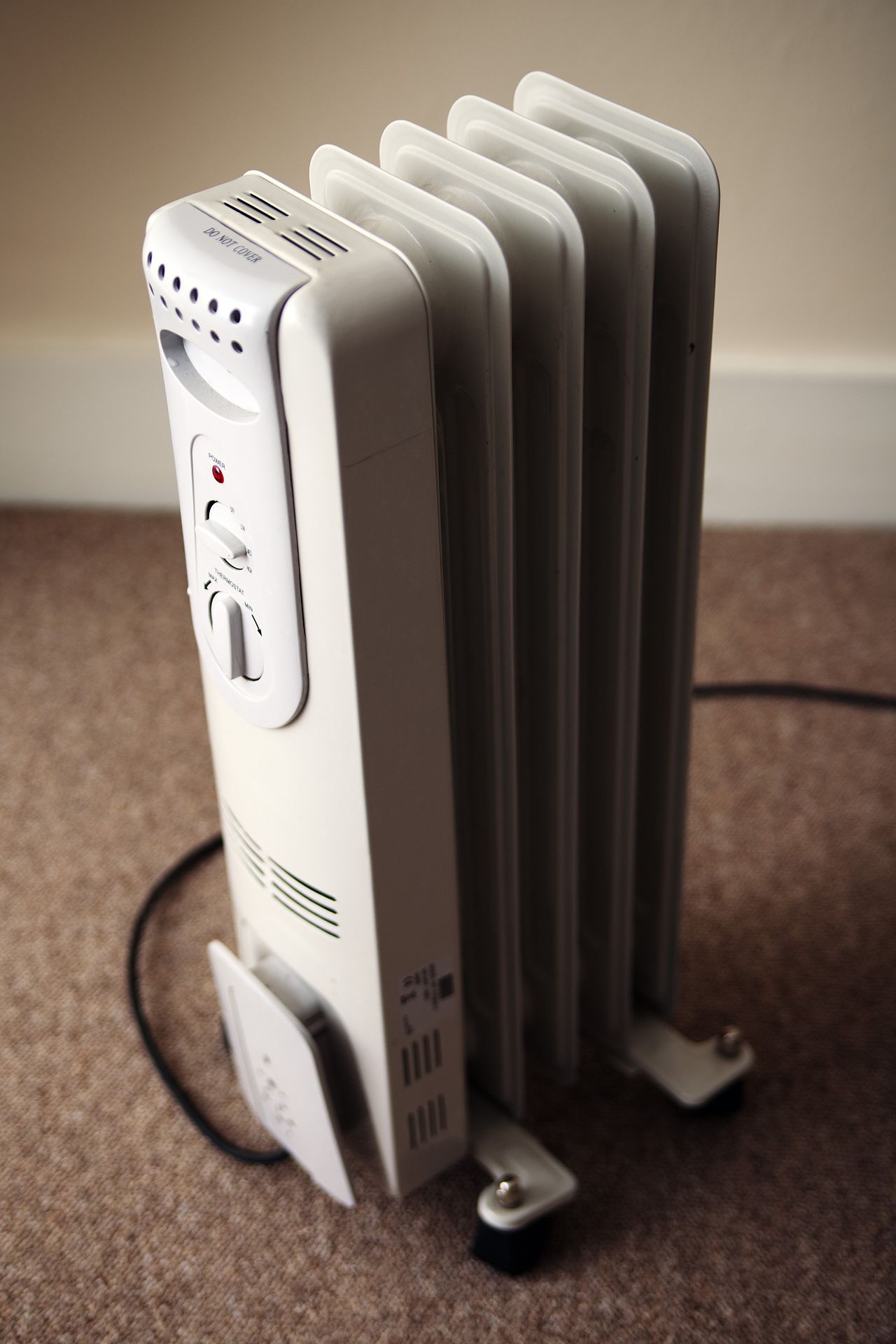
You bought the heater, you read the box, and the box said three feet. Then you looked at the room and realised the sofa is thirty inches from the only outlet.
So the real question is whether three feet is a legal disclaimer or a physical limit. It is closer to a physical limit than most people assume.
This page gives you the number, where it came from, and the four situations where three feet is genuinely not enough.
It also tells you the parts of the rule that get ignored. The back and the top of the heater are the sides people forget.
What is the safe space heater distance from furniture?
Three feet, measured from every surface of the heater. That is the space heater distance from furniture given by the fire service, the manufacturers, and the labels moulded into the plastic.
Three feet is roughly one long stride, or the width of a standard interior door. Pace it out once and you will never have to measure again.
The critical word is every. Three feet in front, three feet behind, three feet to each side, and nothing hanging over the top.
People measure the front because that is where the heat comes out. The back and the sides are where the failures actually happen.
A heater tucked against a sofa arm has zero clearance on one side. The grille is aimed safely into the room, and the fire starts behind the machine.
The full set of operating rules, including run time and outlets, is in how to use a space heater safely. This page is only about the distance.
Why three feet, and where did the number come from?
Three feet is not a round number picked for a poster. It comes from how far usable radiant heat travels from a domestic heating element.
A glowing element runs somewhere between 1,100 and 1,800 degrees Fahrenheit on its surface. That energy falls off fast with distance, but not instantly.
Common household materials ignite in a range most people underestimate. Paper and cotton go around 450 degrees, and polyurethane foam softens and burns lower than that.
- At six inches: a fabric surface can reach ignition temperature in minutes on a high setting.
- At one foot: fabric gets hot enough to scorch, dry out and become far easier to ignite.
- At two feet: most materials only warm, but a fault or a tipped heater erases the margin instantly.
- At three feet: radiant energy has dropped enough that a normal heater cannot ignite a normal material.
- Beyond three feet: the risk moves from the heater itself to the cord, the plug and the outlet.
So three feet is the point where the physics stops being the problem. It is a margin for accidents, not a hard cliff edge.
It matters because more than half of home heating fire deaths came from fires that started when the equipment was too close to something that could burn, according to NFPA.
What counts as furniture, and what do people forget?
The three foot rule is written about furniture, but furniture is rarely the thing that catches. Soft, thin and loose items are the real fuel.
Ranked roughly by how often they show up in real heating fires, here is what has to stay outside the circle.
- Bedding and blankets: a duvet that slides off the bed overnight closes the gap while you are asleep.
- Curtains and drapes: they move. A three foot gap becomes a zero foot gap when a window is opened.
- Laundry: drying clothes on or near a heater is the single most common deliberate mistake people make.
- Rugs and carpet edges: both a fuel and a tipping hazard, which is a bad combination.
- Cardboard, paper and mail: stacked boxes near an outlet look harmless and ignite at a low temperature.
- Upholstered furniture: the foam inside a sofa or armchair burns far faster and hotter than the fabric outside it.
- Pet beds and toys: often placed deliberately near the heat, and often moved by the pet.
Notice how many of those move on their own. That is the argument for three feet rather than eighteen inches you measured once.
Furniture that cannot move, like a solid wood dresser, is the least of your worries. Anything textile is the priority.
Melted synthetics also leave residue behind even when nothing catches properly, which is worth knowing about if you find soot after a small fire near the heater.
Does the space heater distance from furniture change by heater type?
The published rule is three feet for all of them. In practice the space heater distance from furniture you should actually use depends on how the machine makes heat.
- Radiant and infrared heaters: visible glowing element, heat you feel on skin across a room. Three feet is a genuine minimum, and more is better.
- Quartz and halogen bar heaters: the same radiant risk with a very hot exposed tube. Treat these as the highest risk category.
- Ceramic fan heaters: the element is shielded and the heat is blown out. Three feet in front, and never block the rear air intake.
- Oil filled column radiators: the whole body stays under about 200 degrees, so ignition risk is lowest. Still three feet, mostly because of draped fabric.
- Propane and kerosene heaters: a different problem entirely. These are outdoor or garage machines and add carbon monoxide to the picture.
If you can hold your hand near the element and feel it burning within a second, you own a radiant heater. Give it four feet and stop worrying.
Oil filled radiators are the ones people safely tuck behind furniture. It is still a bad habit, because the fabric traps heat against the panel.
Is the distance the same on all four sides?
Yes for the fire risk, and there is a second reason for the back. Fan heaters draw air in from behind, and a blocked intake overheats the element.
That is what the DO NOT COVER label is really about. It is warning you about starved airflow, not just about draping a towel over the top.
Above the heater matters too. Shelves, hanging coats, a tablecloth edge and low windowsills all sit in the rising plume of hot air.
One practical test. Stand the heater where you want it, then swing your arm in a full circle at heater height. If you touch anything soft, move it.
What surface should the heater stand on?
A hard, flat, level floor. Not carpet, not a rug, not a table, and not a shelf or a chair, whatever the distance to the nearest sofa.
Carpet fails on two counts. It is fuel sitting directly under a heat source, and it is soft enough to let the heater rock and tip.
Raising a heater onto furniture feels safer because it is further from the rug. In fact it puts the hot part closer to curtains and gives it further to fall.
If the room is fully carpeted, use a hard board or a hearth tile under the unit and keep the three feet. Do not improvise with cardboard.
Already had a scorch mark, a melted carpet patch, or a burning smell near a heater? That is a fire that started and stopped, and it needs looking at before the next cold night.
(844) 810-6096Does a tip-over switch or auto shutoff change the distance?
No. Those features solve different failures from the one the three foot rule solves, and it is worth knowing which is which.
A tip-over switch cuts power when the heater falls over. It does nothing about a curtain that has been resting against a hot grille for twenty minutes.
An overheat cutout trips when the internal temperature climbs, usually from a blocked intake. By then the outside surface is already hot enough to matter.
Both are genuinely worth having, and a heater without them should be replaced. Neither one buys you a shorter clearance.
The same logic applies to the electrical side. Warning signs like a warm plug or a scorched faceplate are covered in the warning signs of an electrical fire.
What matters more than the distance?
Three things, and any one of them will beat a perfect three foot circle if you get it wrong.
- Plug it directly into a wall outlet. No extension cord, no power strip, no multi-way adapter. A 1,500 watt heater is a 12.5 amp load.
- Never run it unattended or overnight. Turn it off when you leave the room and when you go to bed, every time.
- Check the cord and the plug by hand. A cord that is warm along its length, or a plug that is hot, means the circuit is being pushed too hard.
Overnight use is where the deaths cluster. A heater running beside a bed for eight hours with nobody awake has a very long time to find a fault.
The wiring behind the outlet is the other half of this. Preventing an electrical fire covers the circuit side, which older houses fail more often than people expect.
If an outlet smells hot when the heater is running, stop using it that night. A burning smell from an outlet is not something to test twice.
How do you set the room up so three feet is automatic?
Stop measuring and choose a permanent spot instead. Rooms where the heater lives in one safe place have fewer accidents than rooms where it wanders.
- Pick a hard floor spot with a wall outlet within reach of the factory cord and nothing soft within a stride in any direction.
- Face it into the open room, not into a corner, a sofa back, or a doorway people walk through.
- Mark the spot if you need to, with a hearth tile or a small board, so it goes back to the same place every time.
- Check the circle before you switch it on, because laundry, blankets and boxes migrate during the day.
- Switch it off at the wall when you leave the room, rather than trusting the thermostat to idle safely.
Bedrooms deserve one extra rule. If the only safe spot is within three feet of the bed, the room does not have a safe spot for a portable heater.
Working smoke alarms are the backstop for all of this, and a heating fire that starts at 2am is exactly the case they exist for.
Not sure whether a scorch mark on a wall or carpet is cosmetic or the start of something? A quick call can tell you whether it needs more than a repaint.
(844) 810-6096What if something has already scorched or burned?
Treat a scorch mark as information rather than damage. Something reached ignition temperature, and the only reason it stopped was luck or timing.
Stop using that heater in that position. Then look for what was touching it, because the mark tells you which direction the clearance failed.
If anything actually caught, even briefly, the residue matters more than the char. Melted synthetics leave an acidic film that keeps working on nearby metal and plastic.
For anything past a scorch mark, the ordered first steps are set out in what to do first after a house fire.
The summary is short. Three feet on every side, on a hard floor, plugged straight into the wall, off when you leave. The distance is the easy part to get right.
Common questions
How far should a space heater be from a bed?
Three feet from the mattress, the bedding and anything hanging off the side, measured while the bed is made and again while it is slept in. Bedding moves overnight, which is why bedrooms are the worst room for portable heaters. If the only outlet puts the heater inside three feet of the bed, use a different heating method in that room.
Can a space heater be behind a sofa?
No. Behind a sofa means zero clearance on at least one side, and on a fan heater it also blocks the rear air intake that keeps the element cool. The heater looks safe from the front because the grille is pointing into the room, while the actual ignition risk is happening against the upholstery you cannot see.
Is three feet enough for a radiant or halogen heater?
Three feet is the published minimum and it is enough for normal use, but radiant and halogen heaters have an exposed element that reaches well over 1,000 degrees Fahrenheit. If you can feel the heat on your skin from across the room, give it four feet and keep textiles further back than that.
Can I put a space heater on a rug or carpet?
No. Carpet is fuel sitting directly under a heat source, and it is soft enough to let the unit rock and tip. Put the heater on a hard, flat, level floor. If the room is fully carpeted, set it on a hearth tile or a solid board, and keep the same three feet of clearance around it.
Does a tip-over switch mean I can put the heater closer to furniture?
No. A tip-over switch cuts power when the unit falls over, and an overheat cutout trips when the inside gets too hot. Neither one detects a curtain resting against a hot grille or a blanket that slid within a foot of it. They solve different failures from the one clearance solves, so the three feet still applies.
How far should a space heater be from a wall?
Follow the manual, which usually asks for a few inches at the back and sides on a fan or ceramic model so the intake stays clear. A painted plaster or drywall wall is not the fire risk, so the three foot rule is aimed at combustibles rather than the wall itself. Radiant heaters should still not face a wall closely.
Sources
- Heating Safety — National Fire Protection Association
- Residential Building Heating Fires, National Fire Incident Reporting System — U.S. Fire Administration
- Space Heater Safety and the Three Foot Rule — U.S. Consumer Product Safety Commission
- Portable Space Heater Safety Tips — Miami-Dade Fire Rescue
- UL 1278, Standard for Movable and Wall or Ceiling Hung Electric Room Heaters — UL Solutions
- NFPA 70, National Electrical Code, branch circuit loading — National Fire Protection Association
- Home Fire Prevention and Preparedness — American Red Cross
- Homeowner discussions on space heater placement and winter heating habits — Home maintenance community forums


